How Water Play Transforms Neighborhoods
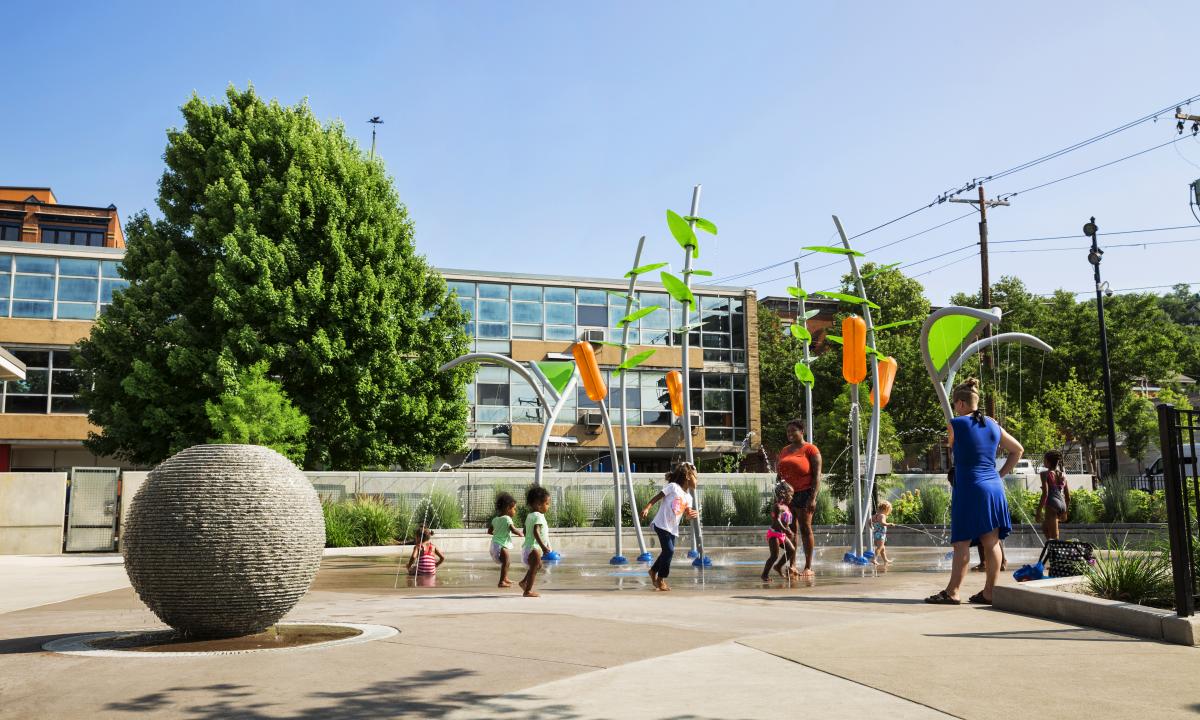
Why Water Play Is Emerging as Social Infrastructure in Urban Neighborhoods
For decades, urban revitalization strategies have treated parks as amenities. They were considered valuable, but often secondary to housing, transportation, and economic development. Play spaces were frequently designed as isolated features, activated seasonally, and evaluated mainly on visual appeal or equipment count.
Today, many cities are beginning to challenge this approach. As municipalities respond to rising temperatures, growing equity expectations, and increased pressure on public space, a new perspective is emerging. When designed intentionally, water play can function as social infrastructure.
Social infrastructure supports everyday presence. It encourages informal interaction and helps public spaces remain active, inclusive, and relevant over time. Water play, in particular, has shown a strong ability to play this role in dense and underserved neighborhoods.
From Amenity to Infrastructure
Unlike traditional park amenities, social infrastructure is not defined by how it looks, but by how consistently it brings people together. Its success is measured through use, presence, and shared experience.
Water play supports this shift because it attracts multiple user groups at the same time, children, caregivers, teens, and older adults, without requiring formal programming. It encourages movement, observation, and moments of pause, creating natural opportunities for social interaction.
In neighborhoods where access to private outdoor space is limited, these qualities are especially important. Well‑used public spaces help parks function as everyday destinations rather than occasional attractions.
Designing for Presence, Not Just Play
A common challenge in park redevelopment is treating individual features as standalone solutions. Splashpads, playgrounds, courts, and lawns are often added independently, without a clear strategy for how people will move through the space or remain in it.
A social‑infrastructure mindset reframes the design process. It focuses on questions such as:
- How does this space encourage people to stay, not just pass through?
- How can different age groups comfortably use the park at the same time?
- What makes the park feel active on an ordinary weekday?
Water play performs best when it is integrated into a broader system. This includes connections to seating, shade, circulation, restrooms, and complementary play areas. In this context, water is not the destination; it acts as the catalyst that activates the surrounding space.
Ziegler Park: Evidence of a Broader Shift
The transformation of Ziegler Park in Cincinnati illustrates this approach in practice. Rather than focusing on isolated upgrades, the redevelopment redefined the park’s role within its surrounding neighborhood.
Previously underused and often perceived as unwelcoming, the park suffered from aging infrastructure and limited year‑round appeal. The redesign focused on activation and inclusivity, bringing together multiple layers of use:
- Renovated sports courts supporting daily activity
- An inclusive playground welcoming children of all abilities
- Multipurpose gathering areas for informal community use
- A central lawn designed for both movement and rest
At the heart of the park is an aquatic zone that combines a deep‑water pool with a themed Splashpad®. Together, these elements support both structured and unstructured experiences, from swimming and spontaneous play to observation and social interaction. This integration reinforces the park’s role as a shared community space rather than a single‑use destination.
Why Participation Shapes Longevity
Another defining element of Ziegler Park’s redevelopment was sustained community engagement. Residents were involved throughout the planning process and helped shape decisions related to layout, accessibility, and programming.
This participatory approach influenced not only the final design, but also how the park is perceived today. Spaces that reflect local needs are more likely to be used regularly, adapted over time, and supported by the communities they serve.
From a planning perspective, participation is not an added step. It is a condition for long‑term relevance.
Evidence on the Impact of Water Play in Underserved Neighborhoods
A national study of urban neighborhood parks reveals a consistent pattern in how aquatic amenities are distributed across urban contexts. In parks located in higher‑poverty areas, defined as neighborhoods where at least 13.5% of households fall below the poverty line, 14 splash pads were identified across 87 parks studied.
By comparison, in more affluent areas, where fewer than 13.5% of households fall below the poverty line, only 5 splash pads were found across 85 parks analyzed.
Rather than indicating unequal access, this distribution suggests a deliberate planning priority. Municipalities appear more likely to invest in water play installations in neighborhoods where access to private outdoor space, cooling amenities, and inclusive recreation is more limited. In these contexts, water play is increasingly viewed as a high‑impact public investment, supporting daily park activation, attracting diverse users, and reinforcing the role of parks as essential community infrastructure.
What This Means for Cities Planning Their Next Park Investment
As municipalities reassess how public spaces support health, equity, and climate resilience, water play deserves reconsideration. Not as a single feature, but as part of a broader strategy.
A social‑infrastructure lens points to several shifts in approach:
- Prioritizing activation over aesthetics
- Designing for everyday use, not only peak moments
- Integrating water play with other amenities rather than isolating it
- Embedding community participation throughout the project lifecycle
Cities that adopt this perspective are better positioned to create parks that remain relevant, resilient, and widely used over time.
Reframing the Role of Play in Urban Life
Ziegler Park illustrates how a coordinated, people‑centered approach to park design can redefine the role of public space at the neighborhood scale. It is evidence of a broader shift in how cities are beginning to think about public space.
When play, and especially water play is designed as part of an integrated, human‑centered system, it can reshape how neighborhoods experience their parks. For urban planners, landscape architects, and municipal leaders, the opportunity lies not in adding more features, but in rethinking what those features are meant to do.
In that reframing, water play becomes more than recreation. It becomes a tool for presence, connection, and everyday urban life.